
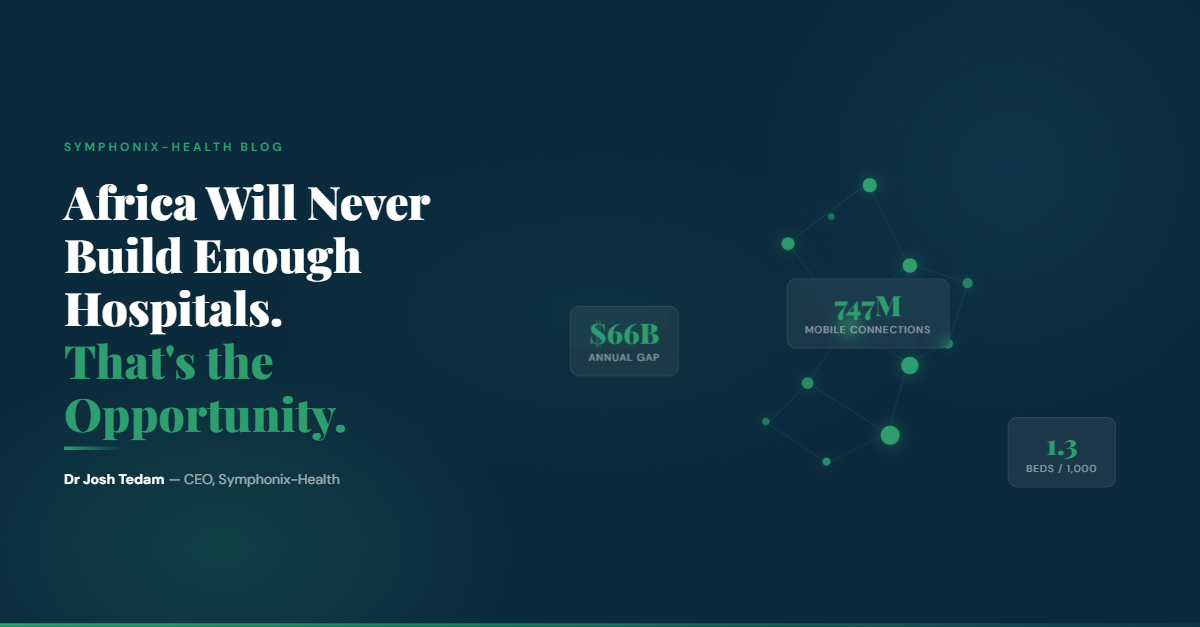
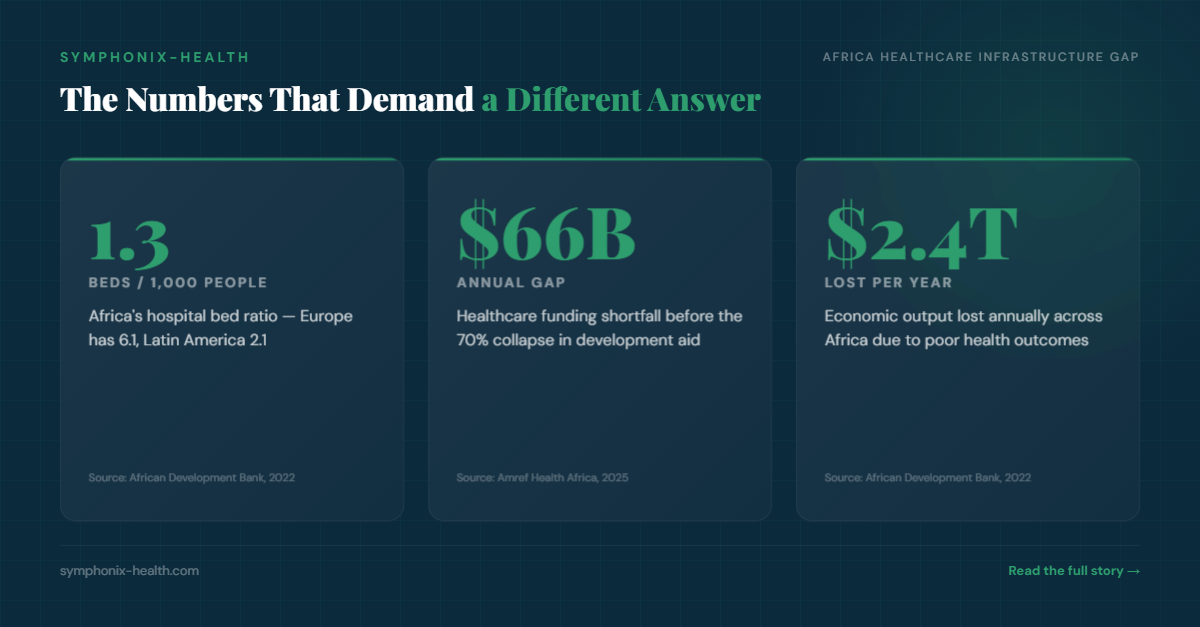
Here is a number that should keep every health minister, hospital CEO, and development funder awake at night: Africa has 1.3 hospital beds per 1,000 people. Europe has 6.1. Latin America has 2.1. Every single African country, except South Africa, falls below the global average of 2.7.
A third of the continent's population lives more than two hours from the nearest health facility. The annual healthcare funding gap stands at roughly $66 billion - and that figure was calculated before the 70% collapse in Official Development Assistance between 2021 and 2025. Public health spending per capita sits at $22–24, against a minimum of $70 required for basic universal coverage.
The arithmetic is unforgiving. You cannot build your way out of a crisis this deep, this fast, with budgets this constrained and a population doubling within a generation.
The continent that couldn't build enough telephone poles leapfrogged to mobile. Healthcare is next.
The Numbers That Demand a Different Answer
Sub-Saharan Africa has just 1.3 health workers per 1,000 people - a third of the WHO's minimum threshold. Public health emergencies surged 41% between 2022 and 2024, from Mpox to Ebola to cholera, overwhelming systems already stretched by decades of under-investment.
The honest assessment? Africa will not close this infrastructure gap through construction alone within any viable timeframe. But it doesn't need to replicate the Western model. The opportunity is to leapfrog directly to a digitally-native care model - where physical facilities serve as nodes in a connected ecosystem, not standalone islands.
Digitalisation: Force Multiplier, Not Substitute
Let's be precise about what digitalisation is not. It is not a replacement for trained clinicians, functional facilities, or sustained capital investment. What it is - and what Africa urgently needs - is a force multiplier. A way to extend the reach, speed, and intelligence of whatever infrastructure and workforce already exist.
Sub-Saharan Africa has approximately 747 million mobile connections, covering 75% of the population. Mobile health is already one of the fastest-growing digital sectors on the continent. The connectivity is there. What is missing is the orchestration layer - the platform that turns fragmented digital initiatives into a coherent national health ecosystem.
This is precisely the problem Symphonix Health's BulletTrain platform was designed to solve.
The AI Agent Revolution in Healthcare
Africa's core constraint is not just buildings - it is skilled clinicians. AI agents address this by acting as cognitive extensions of health workers. A community health worker with a smartphone and an agent-backed clinical decision-support system can perform structured triage, flag critical symptoms, and route patients to the appropriate level of care - work that would otherwise demand a trained physician. The agent does not replace clinical judgement. It encodes it and makes it portable.
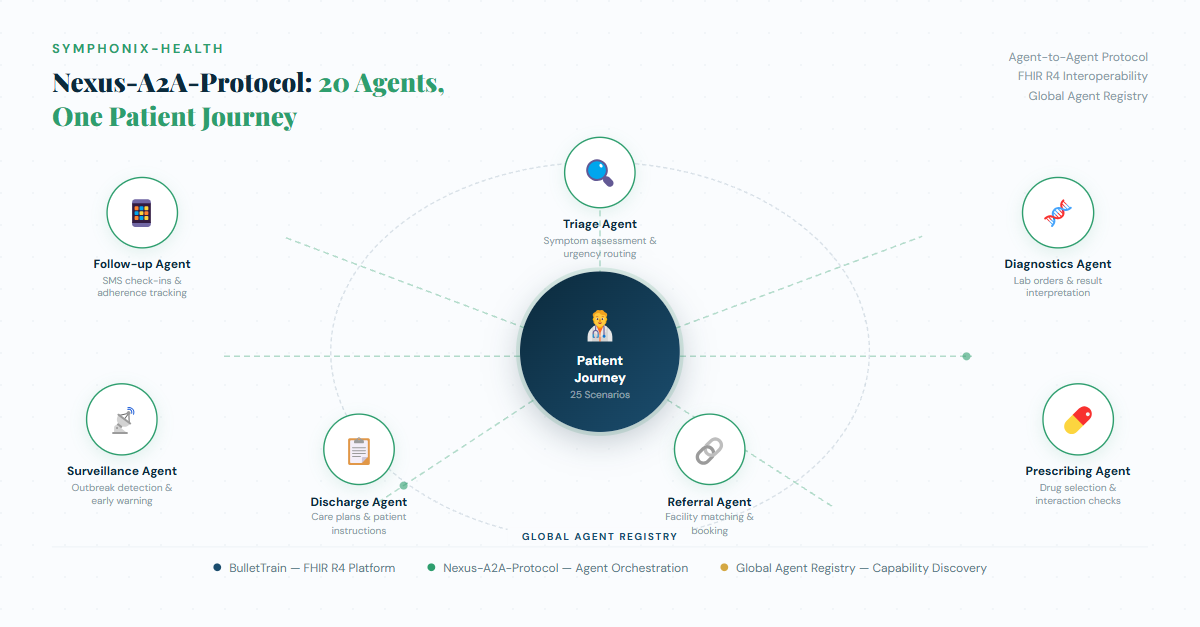
At Symphonix Health, we've built this into our Nexus-A2A-protocol - a 20-agent hospital management system designed around 25 real-world patient journey scenarios. Each agent handles a domain-specific reasoning task: intake triage, diagnostics coordination, prescribing, referral management, discharge planning, follow-up scheduling. They discover and invoke each other through a shared protocol, meaning the system grows incrementally as each new capability comes online.
One doctor. Twenty agents. A thousand patients reached. That's the maths of AI-augmented healthcare.
Five Ways AI Agents Transform Care Delivery
1. Autonomous Triage and Routing
An intake agent assesses symptoms against nationally approved clinical pathways - NICE, WHO, local ministry guidelines - determines urgency, and routes patients to telemedicine, pharmacy, or facility-based care before a human clinician is involved. In a system where one doctor serves thousands, this filtering is transformative.
2. Context-Aware Pathway Personalisation
Standardised clinical pathways are the evidence spine. A pathway agent then adjusts recommendations based on patient-specific context: comorbidities, medication history, local drug availability, distance to the nearest laboratory. The agent does not invent medicine. It adapts evidence-based care to real-world conditions on the ground.
3. Coordination Across Fragmented Systems
Primary clinics, district hospitals, labs, pharmacies, and community health workers typically operate in silos. A multi-agent system orchestrates handoffs between these actors in real time. One agent manages the referral. Another tracks the lab result. Another triggers the prescription. Another schedules the follow-up. No single human could coordinate this across a distributed system.
4. Continuous Surveillance and Early Warning
Agents monitoring aggregated patient data can detect disease outbreaks, medication stock-outs, or unusual mortality patterns far earlier than manual reporting. An agent watching FHIR-based data streams can raise an alert before a local outbreak becomes a regional crisis.
5. Knowledge Democratisation
A clinical knowledge agent serves as an always-available reference for health workers in remote settings - answering drug interaction queries, surfacing relevant guidelines, or walking a nurse through a procedure they've rarely performed. This distributes specialist knowledge to the periphery of the health system where it is needed most.
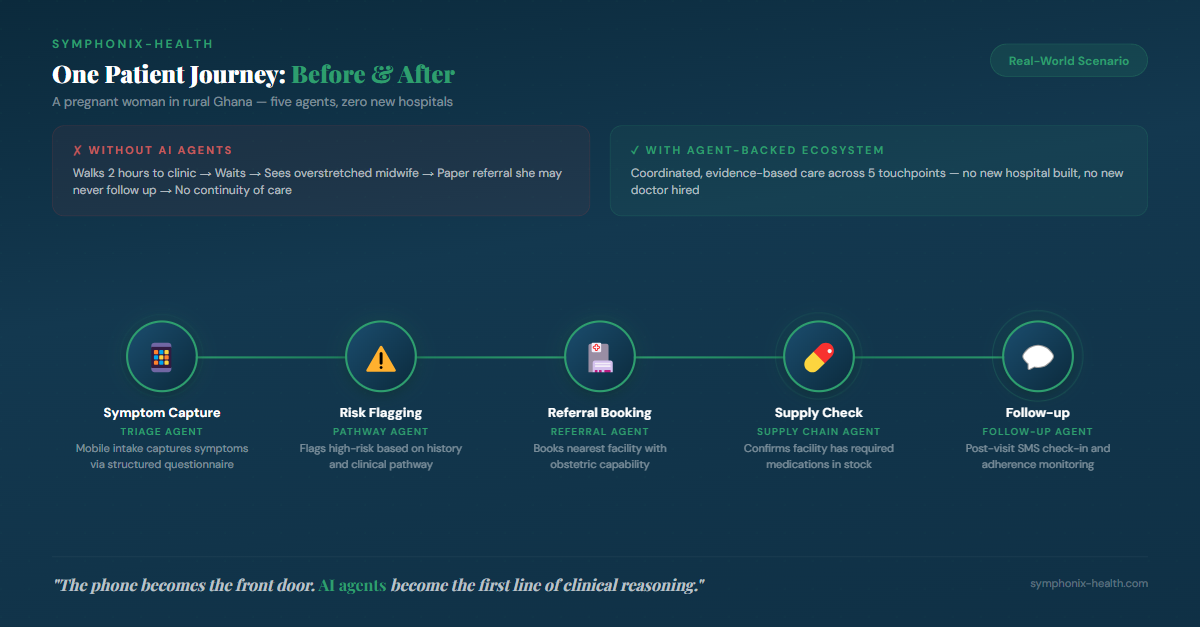
One Patient Journey: Before and After
Consider a pregnant woman in rural Ghana.
Without AI agents: She walks two hours to a clinic. She waits. She sees an overstretched midwife. She receives a paper referral she may never follow up on. There is no continuity of care.
With an agent-backed ecosystem: A mobile triage agent captures her symptoms. A pathway agent flags her as high-risk based on her history. A referral agent books her into the nearest facility with obstetric capability. A supply chain agent confirms the facility has the necessary medications. A follow-up agent checks on her post-visit via SMS.
No new hospital was built. No new doctor was hired. But the system just delivered coordinated, evidence-based care across multiple touchpoints.
The phone becomes the front door. AI agents become the first line of clinical reasoning. Interoperability becomes the nervous system that ties it all together.
Why Multi-Agent Architecture Matters
A single monolithic AI system would buckle under these conditions. The power of the Agent-to-Agent (A2A) protocol approach is composability:
- Incremental deployment. A country can deploy a basic triage agent first, then add pharmacy, referral, and surveillance agents as capacity grows. Each step delivers immediate value.
- Cross-border interoperability. Different agents can be built by different teams - or different countries - and still interoperate through the shared protocol via the Global Agent Registry.
- Graceful degradation. When an agent is unavailable (unreliable connectivity is a reality across much of the continent), the system degrades gracefully rather than collapsing entirely.
The Leapfrog Moment Is Now
Africa's health challenge is real and structural. No amount of optimism erases the $66 billion funding gap, the workforce shortages, or the infrastructure deficit. But the lesson of mobile telephony is instructive: when the established path is blocked, new technology creates an entirely different route.
At Symphonix Health, we are building that route. BulletTrain provides the FHIR-based interoperability platform. Nexus-A2A-protocol provides the intelligent agent layer. The Global Agent Registry provides the discovery and coordination fabric.
Together, they form the foundation for a national digital health ecosystem - one country at a time.
The question is no longer can Africa afford to go digital. It's whether it can afford not to.